
FM Group Newsletter
Autumn 2026
Introduction
FROM THE DIRECTORS
Welcome to the Autumn edition of our newsletter.
During the first two months of 2026, the forestry sector was settling into a period of stability, supported by more consistent export pricing and demand from both India and China, along with a stable domestic market. Windthrow salvage operations in Canterbury and Nelson were in full swing, and some exporters were offering fixed prices to help balance supply logistics.
Fast forward one month, and the sector is now contending with a global fuel shortage, creating pressure across many aspects of everyday life, particularly within the forestry harvesting and transport sector. Forest Management Group is working closely with forest owners and contractors to minimise these impacts as much as possible, although the uncertainty surrounding the situation remains one of the most challenging factors.
Beyond these global events, Forest Management Group continues to invest in its team to ensure the highest level of service for clients, with three new staff joining the company across the country. It is both rewarding and exciting to work alongside some of the best forest management professionals in the industry.
Finally, several members of the team will once again be competing in the Tranz Alpine Scooter Safari in support of the Cancer Society. This event of endurance and camaraderie remains popular for the Forest Management Group, and 2026 looks to be no exception.
Warwick Winn
Director
Log Market Update
The forestry sector is currently facing significant financial headwinds, primarily driven by volatility in fuel pricing which is creating operational instability for both forest owners and contractors. To put this in perspective, production averages 12 litres of diesel per tonne of logs produced.
While this cost inflation has been partially recognised in the China market - with CFR prices increasing by $8 USD since March - these gains have been largely neutralised. Substantial increases in freight costs, fuelled by rising energy prices and currency fluctuations, have effectively offset the higher CFR values.
Export Market Dynamics (China)
The Chinese manufacturing sector has transitioned back into expansion following two months of contraction. This momentum is largely attributed to the post-Chinese New Year resumption of industrial activity.
Key Market Indicators:
• Port Inventory: Currently stands at 2.7m m3
• Daily Offtake: Approximately 65,000 m3/ per day.
Future CFR pricing over the coming months remains contingent on three critical factors:
• Wholesale Stability: The China wholesale market is currently stable but remains fundamentally weak.
• Geopolitical Risk: The trajectory of the conflict in Iran and its impact on global energy markets.
• Supply Discipline: While industry messaging indicates a reduction in volume, actual shipments remain high due to ongoing salvage harvesting across much of New Zealand.
Domestic Market Outlook
Domestic demand is beginning to show early signs of softening. We anticipate further weakening if geopolitical instability continues to erode broader business confidence. Simultaneously, supply to onshore processors is constrained due to the diminishing quality of timber resulting from storm salvage operations in the lower North Island and throughout the South Island. This supply shortage is further exacerbated by a gap in age-class distribution - a legacy of low planting rates in the early 2000s.
In response to these challenges, domestic operators have implemented price adjustments to help mitigate the impact of escalating diesel costs. While the entire supply chain is collaborating to maintain production levels, the current cost structure is nearing a point that may be unsustainable in the long term.
ETS - Carbon Price Update
The Emissions Trading Scheme (ETS) is a market-based policy tool designed to reduce greenhouse gas emissions by putting a price on pollution. Participants are required to buy carbon credits (NZUs) to offset their emissions. Each NZU equates to 1 tonne of carbon dioxide.
NZU prices have remained volatile through the first part of 2026. Prices dipped into the mid-$30s early in the year before recovering into the low-to-mid $40s through March, and more recently moving back into the mid $40s. At writing the carbon price has last traded at $48 per NZU.
At current levels, NZU prices remain well below the Government ETS auction floor price for 2026 of $71 per NZU. As expected, recent auctions have not cleared, with secondary market prices continuing to set the effective trading range.
Market confidence has yet to fully recover following the policy changes announced in late 2025. While the underlying ETS framework remains in place, the removal of the formal link to New Zealand’s international climate commitments created a period of uncertainty, and sentiment continues to play a material role in day-to-day price movements.
2026 is also the first year of a new Mandatory Emissions Return Period (covering 1 January 2023 to 31 December 2025). This has resulted in additional NZUs entering the market as forestry participants file returns and, in some cases, monetise credits. Early- year supply has been concentrated in January, with selling pressure easing through February and March. This pattern is consistent with previous emissions return years.
Trading activity continues to be driven largely by timing decisions rather than strong conviction in either direction. Buyers remain selective and price-sensitive, while sellers are generally more comfortable engaging once prices are back around their target price level.
Looking ahead, carbon price movements through the remainder of 2026 are likely to continue reflecting a balance between remaining emissions return supply, ongoing policy signals, and broader confidence in ETS settings as the year progresses. While prices may remain sensitive to short term election uncertainty, greater clarity on policy direction will be important for more sustained stability.
Reminder: Final Emissions Returns due in 2026 (Post-1989 Final Emissions Returns)
If you have post-1989 forest land in the Emissions Trading Scheme (ETS), we are required to submit a Final Emissions Return on your behalf between the start of January and the end of June 2026. This is the opportunity to claim carbon credits (NZUs) for the previous Mandatory Emissions Return Period (01/01/2023 - 31/12/2025).
Please notify us if any of the following need updating before submission: Harvesting and/or cleared areas
Replanting Information
Areas of storm damage, mortality, etc.
Changes of species
Please contact us if you have any information to update and/or you have any questions.
Ekos Forever Forests
A Joint Venture Enhancing the Value Forest Management Group Delivers to Clients
Ekos Forever Forests is a joint venture between Ekos and Forever Forests (75% owned by Forest Management Group). This partnership combines FM Group’s 30 years of commercial forestry expertise with specialist carbon and environmental capabilities.
Our Purpose
We help landowners, corporates, and investors develop high-integrity forest carbon and nature-positive projects across Aotearoa New Zealand. Our end-to-end model includes:
• Native Forest & ETS: Regeneration, continuous cover forestry, and NZ ETS/ voluntary market development.
• Carbon Services: Footprint measurement, reduction strategies, and certification.
• Long-term Management: Transitioning exotic forests to native ecosystems and long-term land stewardship.
Adding Value to FM Group Clients
Clients can access carbon and environmental markets without changing their existing forestry partner. While FM Group leads operations and harvesting, Ekos Forever Forests provides:
• Carbon modelling, biodiversity credits, and market expertise.
• Net zero strategies and climate sustainability advisory.
• GIS, remote sensing, and nature-based investment structuring.
Who We Work With
We support landowners, corporate partners, and investors seeking to unlock carbon income and climate resilience. Our projects span New Zealand (from Southland to the Central North Island) and the Pacific (Fiji, Vanuatu, and the Solomon Islands).
The Difference
• Integrity: Transparent revenue models with zero "greenwash."
• Stewardship: No "plant and walk away"; focus on long-term protection via covenants.
• Proven Track Record: Experience across ~100 projects, including NZ’s first international voluntary carbon issuance with a Māori landowner.
To learn more, visit www.eff.co.nz, speak with your Forest Management Group representative, or contact:
Chris Myers
021 471 374
Fuel Adjustment Factors
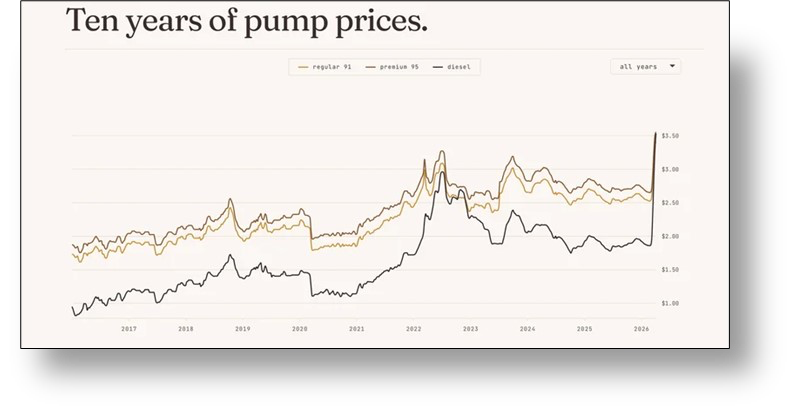
Fuel adjustment factors have not been widely discussed over the past three years of relatively stable diesel prices. A Fuel Adjustment Factor (FAF) is a pricing mechanism used to account for fluctuations in fuel costs over time. It allows rates to be adjusted up or down in response to changes in fuel prices, ensuring that significant fuel cost movements are shared fairly and transparently rather than absorbed by one party.
The base fuel price is the value used by the contractor when calculating the rate they submitted. The FAF is calculated based on the proportion of total operating costs attributable to fuel. This varies depending on crew configuration, the complexity of the harvest, and if the extraction method is by hauler or ground-based.
A FAF is typically applied to the piece rate of the operation, most commonly on a per-tonne basis for harvesting activities, and to hourly rates for contractors such as engineering and other suppliers.
Throughout March, the price of diesel rose by approximately 91% above the 2025 average, and at the time of printing had increased further, sitting around 116% above average. For contractors, fuel typically represents 720% of total operating costs, depending on the activity. For ground-based harvesting this is around 15%, while for cable yarder it is closer to 20%, making this a significant cost pressure to manage.
Fortunately, export log prices have largely rolled over unchanged since March. Increased CFR returns and a softening in exchange rates have helped absorb the rise in shipping costs experienced since the onset of the Iran conflict.
Forest Management Group continues to work closely with customers, contractors, and clients to minimise disruption and cost impacts across the supply chain. In some parts of the country, mills have been able to pass through modest sales price increases on selected grades, while contractors are actively investigating opportunities to reduce fuel consumption where possible.
Looking ahead, we remain committed to pursuing every opportunity to deliver best value to our clients and forest owners while navigating a challenging cost environment.
Tranz Alpine Scooter Safari
FML Team Gears Up for 2026 Tranz Alpine Scooter Safari in Support of Cancer Fundraising
The FML team is back at it again, proudly entering their third squad into the 2026 Tranz Alpine Scooter Safari - and this year’s ride promises to be just as memorable as ever.
Representing the company are four brave (and slightly questionable) adventurers: Corban Lilley, Richard Pearson alongside his dad and Dave Chandler. Swapping comfort for chaos, the team will take on the iconic event aboard their scooters, all in the name of raising funds and awareness for cancer.
Having previously tackled the challenge twice before, FML has built a reputation for bringing both determination and a good dose of humour to the Safari. This year looks to be no different, with the lads already gearing up for a day filled with camaraderie, questionable mechanical decisions, and plenty of laughs along the way.
Of course, no FML outing would be complete without a few “hijinks” thrown into the mix, whether that’s pushing scooters to their limits, tackling the terrain with creative problem-solving, or simply enjoying the journey with mates.
As the 2026 Tranz Alpine Scooter Safari approaches, the team is looking forward to another unforgettable experience, combining adventure, teamwork, and fundraising spirit. Keep an eye out for updates, support the cause, and wish the boys luck as they take on the challenge once again.
They are riding for something much bigger than themselves. Our team is on a mission to turn every kilometre into a contribution for vital cancer support initiatives. It’s a cause close to our hearts, and we’re inviting you to join the movement!
If you’d like to back their fundraising efforts and help them hit their goal, you can find the team’s pages right here:
https://scootersafari.co.nz/t/fml-riders
https://scootersafari.co.nz/t/dave-and-richard
or you can support our individual drivers.
Go well, lads!

From the Backpage
Welcome!

FM Group Marlborough is thrilled to welcome Lawrence Weston as our new Forester.
Lawrence brings over two decades of experience, including 7 years with Rayonier Matariki Forests in Hawke’s Bay. A specialist in forest establishment, silviculture, and harvest supervision, he is also a pioneer in chemical thinning - a process he helped develop and implement across New Zealand.
In his new role, Lawrence will manage client forest operations and provide ETS consultancy. An outdoor enthusiast, he and his son are excited to begin their new chapter in the South Island.

FM Group Nelson is excited to welcome Mike Scally to the team as a Forester.
Mike returns to the region after previously working as a Resource Forester for Hancock Forest Management. Most recently based in Hawke’s Bay, he brings extensive expertise in forest resources and establishment to manage silviculture and forest management for our Tasman and Nelson clients.
A Bachelor of Forestry Science graduate, Mike moved back to the region to raise his family. Outside of work, he enjoys hunting and life on his local lifestyle block.

FM Group North Island is pleased to welcome our newest team member, Hamish Thompson, who joins us as Operations Manager for the Te Wera Forest Estate in the Taranaki District.
Having dedicated his entire career to the agricultural and forestry sectors, Hamish brings an extensive range of technical skills and industry experience to the role. FM Group is thrilled to have a professional of Hamish’s calibre join the organisation. Outside of his professional life, Hamish enjoys camping, fishing and hunting with his family and friends.
Previous issues

Summer 2025/6 Newsletter
In this issue: Log Market Update, ETS Crabon Price Update, Resource Management Act Reform, New Northland Office Details, FMG Rides the Wilderness, Welcome to Matt Pedersen and a Goodbye to Dom Cleary!
Spring 2025 Newsletter
In this issue: Log Market Update, Carbon Price Update, New Farm to Forestry Conversion Rules, Final Emissions Returns due 2026, Tasman Windblow, Adrian Loo Becomes Institute of Directors Chartered Member, Goodbye to Andrew Dennes and FM Group Partnership with Farmlands.